How to Launch an Office Lunch Benefit in 30 Days: HR Checklist and a Full Comparison of Employee Benefits in Germany

Jatin Gagwani
Performance Marketer @Bella&Bona

Choosing a benefit is easy. Choosing one that works, is tax-efficient and gets used is the hard part.
Germany has more employee benefits than most HR teams can track. Each one has its own tax rule, its own limit, and its own paperwork. That’s why many companies end up with benefits that look generous but few people use, or worse, benefits that create payroll problems.
This guide does two things. First, it compares the main benefits employers in Germany offer, with the 2026 tax rules and limits for each, from meal subsidy and vouchers to gym, Jobticket, bike leasing and company pension. Second, it gives you a practical 30-day plan to launch the benefit that most teams use every working day: an office lunch benefit.
As of October 2026. This is not tax or legal advice. Check every setup with your payroll team, tax advisor, and your works council where one exists.
The Benefits Landscape in Germany
Most German employers already offer more than one benefit. In a Roland Berger survey of more than 1,700 HR professionals (published February 2025), companies offered 6.6 benefits on average and planned to add 1.4 more in 2025. Bike leasing alone grew fivefold since 2019 (Roland Berger). The study was run together with a consortium of benefit providers, so read it as a market snapshot, not a neutral ranking.
The same study shows why the choice is hard: 82% of HR leaders say it is difficult to find their way through the many benefit providers, and 27% don’t know the tax allowance for health promotion.
Three Rules That Decide Almost Everything
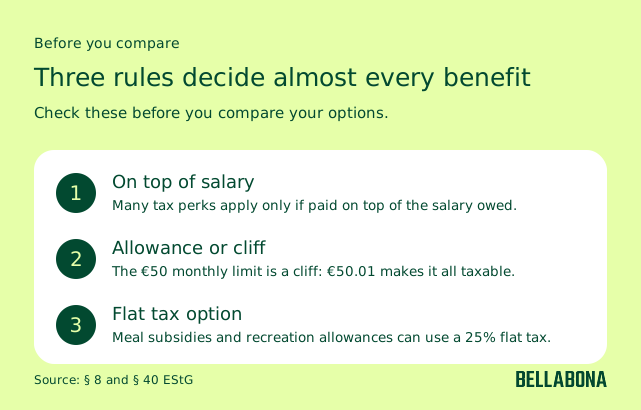
Before comparing benefits, it helps to know the three rules behind nearly all of them.
1. The “on top of salary” rule. Many tax advantages only apply if the benefit is paid on top of the salary the employee is already owed. Salary conversion is often excluded (§ 8 Abs. 4 EStG). Exceptions exist, for example for bike leasing and company pension.
2. Allowance or cliff. Some limits are allowances, so you only pay tax on the amount above them. Others are cliffs: the €50 monthly limit for non-cash benefits is a Freigrenze, so if you exceed it by one cent, the whole amount becomes taxable (§ 8 Abs. 2 Satz 11 EStG).
3. Flat tax as the alternative. For several benefits, the employer can choose a 25% flat tax instead of taxing the employee. This is the case for meal subsidies and recreation allowances (§ 40 Abs. 2 EStG).
Benefits Compared at a Glance
Here are the main options with their 2026 rules. “Used how often” is our assessment, not a statistic.
| Benefit | Tax treatment (2026) | Limit | Used how often | Best for |
|---|---|---|---|---|
| Meal subsidy (Office Lunch) | Official meal value €4.57 plus up to €3.10; flat tax 25% or employee contribution | Up to €7.67 per working day | Every office day | Teams in the office, hybrid teams |
| Gift cards and vouchers | Non-cash benefit, tax-free under the €50 monthly Freigrenze | €50 per month | Occasionally | Small recognition, remote staff |
| Gym and wellness | Courses: tax-free up to €600 a year; general gym memberships mainly via the €50 limit | €600 per year (courses) | Weekly for gym users | Health-focused teams |
| Jobticket (Deutschlandticket) | Employer subsidy tax- and social-security-free if paid on top of salary | Up to the ticket price (€63 per month) | Daily for commuters | City-based teams |
| Bike leasing | Salary conversion: taxed with the 0.25% rule on list price; employer-funded on top: tax-free | By list price | Daily for cyclists | Teams in bike-friendly cities |
| Company pension (bAV) | Tax-free up to €8,112 a year; social-security-free up to €4,056; 15% employer top-up with salary conversion | €8,112 per year | Long-term, invisible day to day | Retention of long-term staff |
| Childcare subsidy | Tax-free if paid on top of salary, for actual costs | No fixed cap | Daily for parents | Teams with young families |
| Recreation allowance | 25% flat tax up to €156 (employee), €104 (partner), €52 (child) per year | €156 per employee per year | Once a year | Holiday-season gesture |
| Small occasion gifts | Tax-free up to €60 for personal occasions | €60 per occasion | Occasionally | Birthdays, anniversaries |
Meal Subsidy: The Benefit People Use Every Day
A meal subsidy covers part of an employee’s lunch. For 2026, the official meal value for a lunch is €4.57. Employers can add up to €3.10 on top, giving up to €7.67 per working day per employee. With 15 subsidised days a month, that is about €1,381 per employee per year. We explain the calculation in our guide to the Sachbezugswert 2026.
Two common setups exist. In the first, the employer bears the meal value and taxes it at a flat 25% under § 40 Abs. 2 EStG. In the second, employees pay at least the official meal value themselves and the employer adds up to €3.10.
Why it stands out: it’s the only benefit on this list that employees use on every office day. That gives it a daily reason to come to the office, and a shared moment for the team.
What to watch: meals must be provided on working days, and the subsidy must not be agreed as part of salary. Agree on no more than 15 subsidies a month to avoid tracking absences.
Our view: best fit for offices with regular attendance and no canteen. See Company Canteen vs. Office Lunch Delivery for a direct comparison.
Gift Cards and Vouchers
Gift cards and prepaid cards can be tax-free under the €50 monthly limit, but only under strict conditions. They may only entitle the holder to goods or services, must fit the criteria of § 2 Abs. 1 Nr. 10 of the German Payment Services Supervision Act (a limited acceptance network or product range), and must be paid on top of salary. Cash payout, bank transfer or PayPal top-up features rule a card out.
The cliff: it’s a Freigrenze, so €50.01 in a month makes the whole amount taxable. The limit applies per calendar month and can’t be saved or carried over. Other Sachbezüge count towards the same €50.
Pros: simple, flexible, reaches remote staff. Cons: easy to exceed by accident, lower perceived value than a daily benefit, and low impact on culture.
Gym and Health Benefits
There are two different routes, and mixing them up is a common mistake.
Certified health courses. Under § 3 Nr. 34 EStG, employers can fund health promotion that meets the quality criteria of §§ 20 and 20b SGB V, for example back courses, stress management or yoga, tax-free up to €600 per employee per year.
General gym memberships. According to IHK guidance, a general fitness-studio or sports-club membership does not fall under § 3 Nr. 34. The alternative is the €50 monthly Sachbezug limit, if the employer is the contract partner or provides an earmarked voucher of at most €50 a month (IHK Bonn).
Corporate fitness platforms such as Wellpass or Urban Sports Club: we found no verified tax guidance for these, so check the exact treatment with the provider and your tax advisor.
Our view: valuable for a health-focused team, but usage is limited to people who already exercise.
Jobticket and Bike Leasing
Deutschlandticket (Jobticket). In 2026 the ticket costs €63 per month. If an employer pays at least 25% (€15.75) through a framework contract, a 5% discount applies. In the IHK example, the employee then pays €44.10. An employer subsidy paid on top of salary is tax- and social-security-free under § 3 Nr. 15 EStG, and the employer can instead apply a 25% flat tax (Deutsche Handwerks Zeitung, Navit).
Bike leasing (Dienstrad). With salary conversion, only private use is taxed as a benefit: one percent of a quarter of the list price, rounded down to full €100. If the employer provides the bike on top of salary, private use is tax-free under § 3 Nr. 37 EStG (Navit). Fast-growing: leasing has grown fivefold since 2019.
Our view: very popular with a part of the team, but only for those who commute by public transport or bike.
Company Pension (bAV)
For 2026, employer contributions to a company pension are tax-free up to €8,112 per year (8% of the contribution assessment ceiling of €101,400), and social-security-free up to €4,056 per year (4%). With salary conversion, employers generally must add at least 15% (TK).
Our view: strong for retention over many years, but employees don’t feel it day to day, so it works best as a complement, not a replacement for visible benefits.
Childcare and Family Benefits
Employer subsidies for the care of non-school-age children in kindergarten or similar facilities are tax-free if paid on top of salary (§ 3 Nr. 33 EStG). There is no fixed cap, but only actual costs can be reimbursed, and salary conversion isn’t allowed (Barmer).
Our view: highly valued by parents, but it reaches only part of the team.
Small Perks That Add Up
- Recreation allowance (Erholungsbeihilfe): 25% flat tax up to €156 per employee, €104 for a partner and €52 per child per year, paid within three months of a holiday (DRV).
- Occasion gifts: tax-free up to €60 for personal occasions such as birthdays or a new baby, not for general holidays.
- Employee discount allowance: up to €1,080 per year for goods or services your company sells, according to payroll guidance.
How to Choose: Five Questions
- How often will people use it? Daily benefits shape culture; annual ones feel like a bonus.
- Who does it reach? Everyone in the office, or a subset such as parents or cyclists?
- What are the running costs? A fixed budget per person, or a variable cost?
- How heavy is the admin? Payroll steps, reporting and proof.
- Does it fit how you work? Hybrid teams value benefits that pull people into the office on set days.
| Benefit | Daily use | Reaches everyone | Admin effort |
|---|---|---|---|
| Meal subsidy (Office Lunch) | High | High | Low with a provider |
| Vouchers | Low | High | Low |
| Gym | Medium | Low | Medium |
| Jobticket | High for commuters | Medium | Medium |
| Bike leasing | High for cyclists | Low | Medium |
| bAV | Low | High | High |
| Childcare | High for parents | Low | Medium |
(Ratings are our assessment based on how each benefit works, not survey data.)
The 30-Day Launch Plan for an Office Lunch Benefit
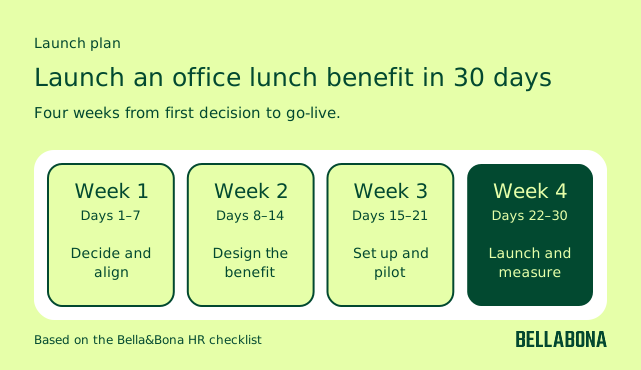
Most of the 30 days go on internal alignment, not on the food. A provider like Bella&Bona can be ready in less than a week, so use the rest of the time to get payroll, management and, where relevant, your works council on board.
Week 1 (days 1–7): Decide and align
- Define the goal: attendance, satisfaction, retention, or all three.
- Count the people in the office and on which days.
- Set a rough budget per person per day.
- Involve payroll and finance early.
- Check whether you have a works council. Under § 87 BetrVG, co-determination can apply, for example for canteens as social facilities (Nr. 8) or for pay design (Nr. 10). Whether it applies to a meal subsidy depends on the case, so get legal advice and involve them early (betriebsrat.de).
Week 2 (days 8–14): Design the benefit
- Choose the tax model: employer flat tax, or an employee contribution plus employer top-up.
- Set the daily subsidy within the limit (up to €7.67 per day) and the number of subsidised days.
- Choose a provider and request a proposal.
- Agree on the 15-days-per-month rule to avoid absence tracking.
- Have payroll sign off on the reporting.
Week 3 (days 15–21): Set up and pilot
- Run a free trial lunch with a pilot group.
- Employees register with their work email and order in the app or browser.
- Prepare the communication: announcement, Slack copy and an FAQ.
- Collect feedback on food, timing and ordering.
Week 4 (days 22–30): Launch and measure
- Go live with the full team.
- Track participation and ordering from day one.
- Fix early issues quickly: dietary options, delivery time, budget.
- Schedule a review after 90 days.
The HR Checklist
☐ Goal and success metrics defined
☐ Headcount and office days confirmed
☐ Budget per person per day set (up to €7.67)
☐ Works council informed or agreement prepared
☐ Payroll and tax advisor confirmed the model
☐ Provider shortlisted and proposal received
☐ 15-subsidies-per-month rule agreed
☐ Free trial lunch held
☐ Dietary needs collected (vegan, vegetarian, halal, gluten-free, allergens)
☐ Announcement and Slack copy ready
☐ Employee registration process tested
☐ Reporting for payroll tested
☐ Go-live date and owner named
☐ 90-day review scheduled
Measuring Success
Track a small number of numbers from day one:
- Participation rate: share of eligible employees who order at least once a week.
- Orders per participant per week.
- Satisfaction: a short pulse survey after four weeks.
- Attendance on subsidised days compared with other days.
- Cost per participant, against the budget.
- Waste: returns of reusable containers.
With a dashboard such as Bella&Bona’s Command Center you can see participation, satisfaction and ordering by team in one place. Bella&Bona reports around 92% adoption among employees at customer offices (internal figure).
Common Mistakes
- Converting salary into a benefit that must be paid on top of it.
- Going over a Freigrenze by a cent, as with the €50 monthly limit.
- Choosing a card with cash features, which rules out the tax advantage.
- Skipping the works council where co-determination may apply.
- Not agreeing on the 15-subsidies rule and then tracking every absence by hand.
- Launching without a trial, so problems show up in front of everyone.
- Measuring nothing, so nobody can say after six months whether it worked.
FAQ
Which employee benefits are tax-free in Germany? Several, within limits and usually only if paid on top of salary: for example up to €50 a month in non-cash benefits, a Jobticket subsidy, certified health courses up to €600 a year, and childcare subsidies for actual costs.
How much can an employer subsidise lunch in 2026? Up to €7.67 per working day: the official meal value of €4.57 plus up to €3.10.
Can an employee pay for a gym membership through the employer tax-free? General memberships are mainly handled through the €50 monthly limit. Certified health courses can be tax-free up to €600 a year.
How long does it take to launch an office lunch benefit? The provider side can be ready in less than a week. Plan around 30 days for internal alignment with payroll, management and any works council.
Do I need to involve the works council? If you have one, ask early. Co-determination under § 87 BetrVG can apply, depending on how the benefit is set up. Get legal advice.
What is the 15-meal rule? If you agree on no more than 15 subsidised meals per month, you don’t need to track absences such as holiday or sickness.
Is a voucher or a meal subsidy better? A voucher is flexible but limited to €50 a month and used occasionally. A meal subsidy is used every office day and has a higher limit.
Is salary conversion allowed for meal subsidies? The subsidy has to be provided on top of salary and not agreed as part of it. Confirm the details with your payroll team.
Sources
Office Lunch
Launch Office Lunch in under a week
Set your budget and service days, and we handle setup, delivery and reporting. Start with a free trial lunch.