15 Return-to-Office Incentives That Actually Work

Jatin Gagwani
Performance Marketer @Bella&Bona

Companies who want to adopt return to office policies have a core question to answer: Which incentives create real value for employees, making office days feel more valuable, social, and useful?
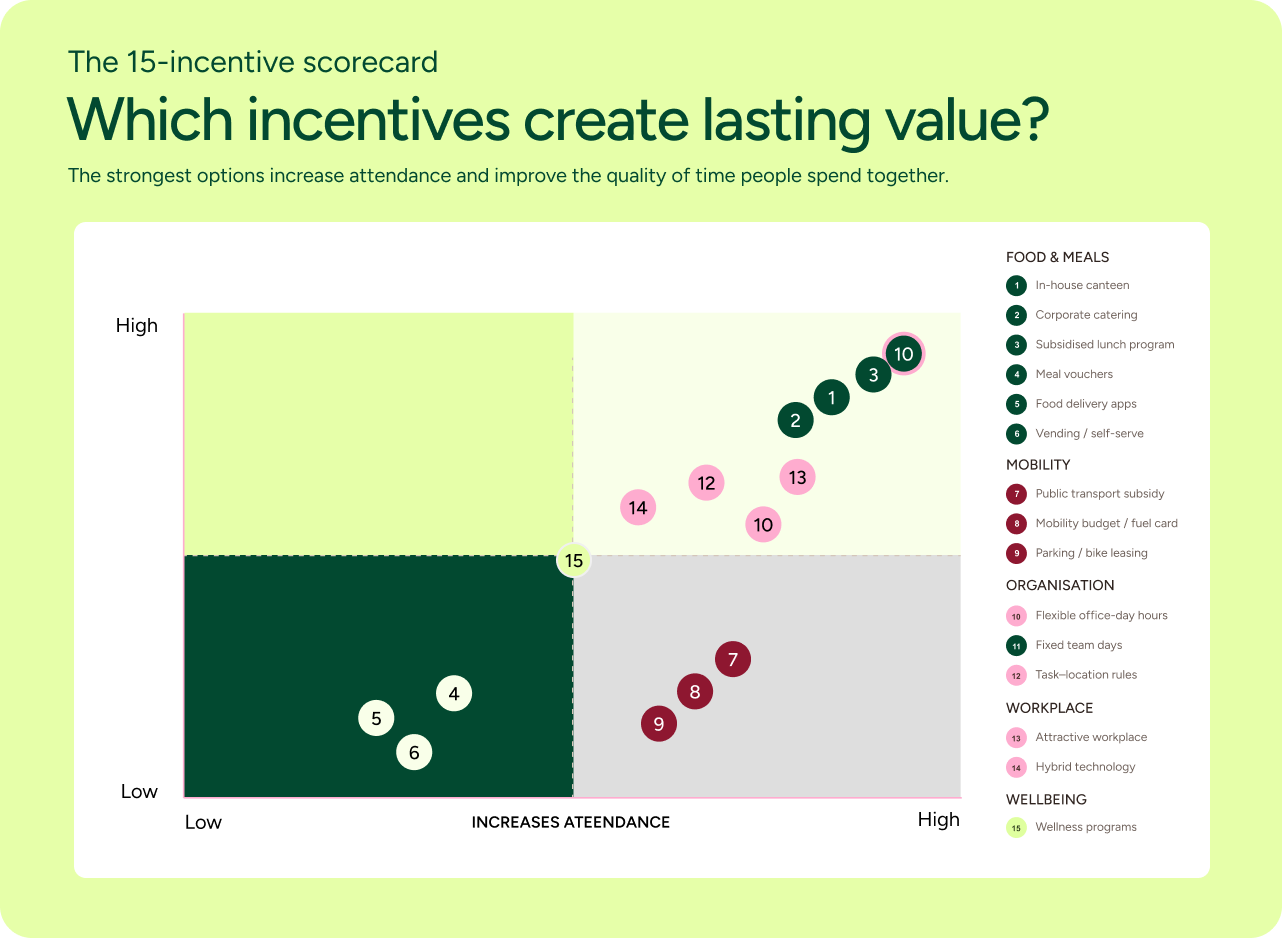
In this article, you'll find 15 return-to-office incentives that are practical, realistic, and relevant for everyday work. We'll look at which office incentives actually help, which office perks remain too symbolic, and how employee benefits, workplace culture, flexibility, and the office environment all shape the return.
Food and meals

1) In-house canteen
Free food is a powerful and popular draw. Offering meals in the office can reduce the time employees spend preparing food at home. The canteen is recurring, social, and built into the rhythm of work, creating a shared place where people and team members naturally meet. Varied, rotating, as well as healthy and sustainable meal options are key to improving satisfaction, as well as curiosity about the workplace.
Best for: larger companies, central locations, many employees
Watch out: high fixed costs, limited flexibility
2) Corporate catering
Regular catering can become one of the most effective return-to-office incentives because it connects meal time with community and culture. When regular catering becomes a real office ritual it can create exactly the kind of shared social moment many employees say they miss when working mainly from home.
Best for: companies with fixed on-site days
Watch out: without a shared format, the benefit stays limited
3) Structured lunch program with employer subsidy
Lunch reduces daily friction, saves prep time at home, and gives colleagues a natural reason to pause together in a more relaxed setting. Flexibility in choosing a dish, and healthy, well-designed food offers can support employee satisfaction (Source: Harvard Business School Library), and connects work, routine, community, and retention.
Best for: hybrid organizations, regular office days
Watch out: works best with clear rules and reliable execution
4) Meal vouchers
Meal vouchers are simple, which is part of their appeal. But they are often location-independent, which means they do not necessarily bring employees back to the office.
Best for: general appreciation
Watch out: weaker as a real office-attendance lever
5) Food delivery apps as a benefit
These can be convenient, but they are often too individual. They rarely create shared team moments or stronger workplace culture.
Best for: remote-heavy structures
Watch out: low social effect
6) Vending machines, frozen meals, or self-serve formats
These can solve basic food access. But as return-to-office incentives, they are usually weak.
Best for: basic workplace provision
Watch out: can make a poor office environment feel even more transactional
Mobility and convenience

Gallup reports that commuting time increased by 10% between 2006 and 2019, that longer commutes are linked to lower leisure satisfaction and poorer wellbeing, and that even a 30-minute commute is associated with higher stress and anger. That is why commuter benefits matter more than many employers assume (Source: Gallup).
7) Public transport subsidy or job ticket
A flexible budget for public transport, job tickets, or shared mobility can reduce the financial pressure of commuting and make office attendance feel more manageable. It lowers the barrier to getting into the office, especially in cities.
Best for: commuters, urban companies
Watch out: does not automatically improve collaboration
8) Mobility budget or fuel card
These benefits also help people get to the office. For some workers, especially with longer commutes, that can make a real difference.
Best for: decentralised locations, rural regions
Watch out: limited effect on workplace culture
9) Free parking or bike leasing
These measures help solve the route to work, but they do not automatically make the office day itself more valuable.
Best for: low-public-transport locations
Watch out: logistical lever, not a cultural one
Working time, structure, and organisation

10) Flexible working hours on office days
Flexible hours help when family needs, commuting, children, childcare, or private responsibilities shape the week. They can also support work-life balance and reduce friction in the transition back to office routines. This matters especially for parents, pet owners, and people juggling school schedules or childcare services.
Best for: parents, long commutes, complex calendars
Watch out: without shared time windows, collaboration value drops
11) Fixed team or department days instead of "everyone must come in"
One of the best return-to-office incentives is simple: stop asking everyone to come in all the time. Instead, create predictable days where certain teams are together. That helps employees return because the day feels more purposeful and because team days create the kind of collaboration and relationship-building that is harder to achieve virtually.
Best for: larger organisations, cross-functional teams
Watch out: needs coordination across managers
12) Clear rules for which tasks belong where
Not every task belongs in the same place. A clear match between tasks and location helps people understand when to come into the office and when they are better off working remotely.
Best for: knowledge work, hybrid setups
Watch out: needs strong communication and the right tools
Workplace and infrastructure

13) An attractive workplace with good equipment
Good light, strong ergonomics, quiet zones, collaboration areas, and flexible office space all shape how people feel at work. If the office feels clearly better than home for some parts of the day, more people will want to return.
Best for: companies with weak office quality
Watch out: design alone does not replace strategy
14) Technology upgrades for hybrid work
Good tools, smart meeting setups, and better hybrid systems improve the quality of work. They reduce frustration around calls, improve collaboration, and make it easier for team members in different locations to work together. Digital tools matter, but technology should support human interaction, not replace it.
Best for: hybrid companies, distributed teams
Watch out: technology supports work, but does not replace social value
Culture, benefits, and wellbeing

15) Wellness programs, office yoga, sports, and similar benefits
As awareness of mental and physical health has increased, wellness programs have become more central to office culture and managing stress at work. Health offers such as office massages, fitness classes, mindfulness sessions, and gym memberships not only support employees' general health, but also help connect their lifestyle to their office attendance.
Best for: culture, retention, supportive employee benefits
Watch out: often weaker than structural measures in daily practice
Practical tips for employers, HR, and managers
1: Ask employees what would actually bring them back
Top Workplaces recommends using pulse surveys before, during, and after return-to-work transitions so companies can respond quickly and tie decisions to actual employee feedback.
2: Talk about value, not just policy
Clearly communicated office presence helps employees understand why in-person work matters to their specific role and company.