Why Office Lunch Is Becoming Germany's Most Valuable Employee Benefit

Jatin Gagwani
Performance Marketer @Bella&Bona
Germany Has an Engagement Crisis — And Companies Are Running Out of Easy Fixes
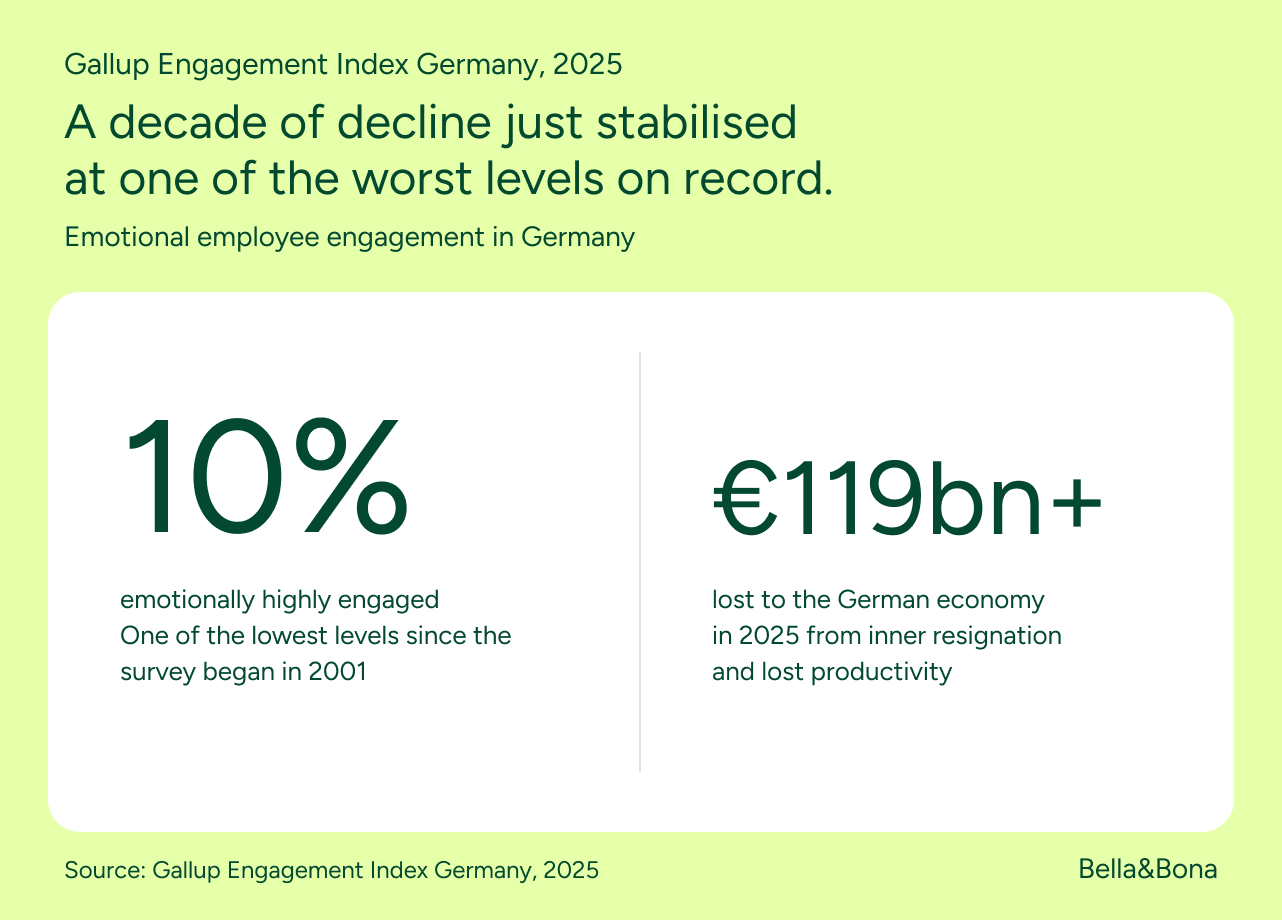
The numbers from Gallup's 2025 Engagement Index for Germany are stark. Only 10% of employees in Germany feel strongly emotionally bound to their employer — one of the lowest figures since the survey began in 2001. The multi-year decline has only just stabilised, and it has stabilised at one of the worst levels on record.
The economic consequences are enormous: in 2025 alone, productivity losses caused by inner resignation cost the German economy more than €119 billion.
HR teams across Berlin, Munich, and NRW are under real pressure to respond. But the standard toolkit — flexible working, training budgets, wellness apps — is running out of headroom. Most companies have already done the obvious things. What is increasingly separating employers that retain talent from those that lose it is something more daily, more physical, and more overlooked than most benefit strategies account for.
Food.
What the Research Says About Nutrition and Work Performance
The link between adequate nutrition and workplace productivity is not opinion. It is documented by the International Labour Organization.
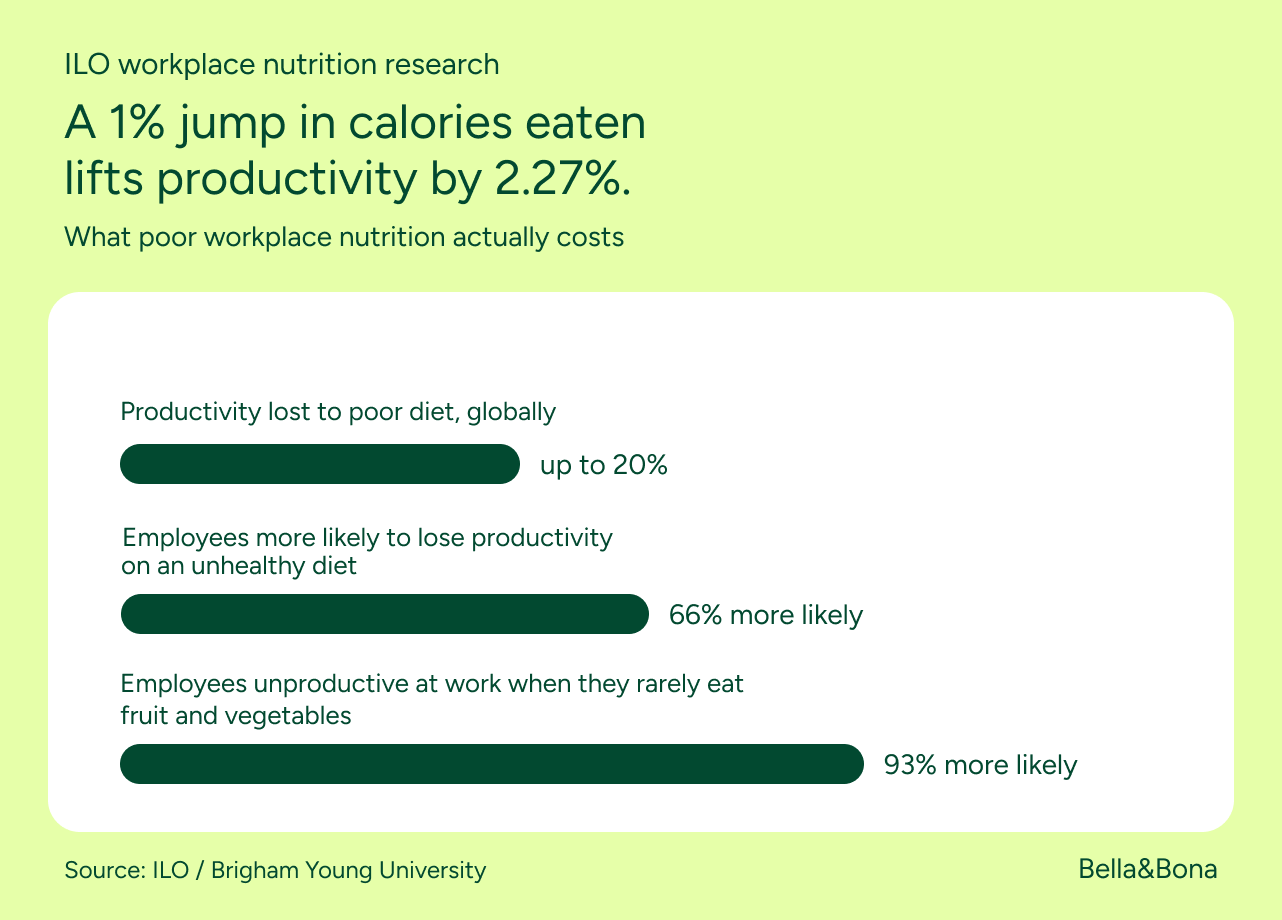
Poor diet on the job is costing countries around the world up to 20% in lost productivity, according to an ILO study — either due to malnutrition or the excess weight and obesity afflicting significant numbers of workers. The same ILO research found that adequate nourishment can raise national productivity levels by 20%, and that a 1% increase in kilocalorie intake results in a 2.27% increase in general labour productivity.
A separate study from Brigham Young University involving 20,000 employees found that those with unhealthy diets were 66% more likely to experience productivity loss, and employees who rarely consumed fruits and vegetables were 93% more likely to be unproductive during work hours.
The ILO's study — the first to examine workplace eating habits worldwide — found that few workers are happy with their meal arrangements. In Germany, where 78% of employees are working in "energy-saving mode", the quality of the daily lunch is not a peripheral HR question. It is connected directly to the performance problem every German company is trying to solve.
Eating Together Is Not a Soft Metric
The most rigorous study on communal eating and team performance comes from Cornell University, published in the journal Human Performance and featured in Harvard Business Review.
Cornell professors found that firefighter platoons who eat meals together have better group job performance compared with firefighter teams who dine solo.
"Eating together is a more intimate act than looking over an Excel spreadsheet together. That intimacy spills back over into work," said the study's author Kevin Kniffin. "From an evolutionary anthropology perspective, eating together has a long, primal tradition as a kind of social glue. That seems to continue in today's workplaces."
Given these findings, the researchers concluded that organizations would do better to consider their expenditures on cafeterias and catered meals as investments in employee performance.
The researchers noted that firefighters expressed embarrassment when asked about firehouses where they didn't eat together. "It was basically a signal that something deeper was wrong with the way the group worked," Kniffin said.

For Berlin and Munich companies trying to rebuild team cohesion after years of hybrid working, this matters. The lunch table is not a perk. It is infrastructure for the kind of daily interaction that builds trust between colleagues — the trust that shows up in performance reviews, project handovers, and retention conversations.
Food Sits at the Top of Germany's Benefits Market
Roland Berger's major survey of more than 1,700 HR leaders in Germany, conducted in Q4 2024, identified the benefits that companies actually prioritise. The result was a clear "Big 5": bike leasing, meals and other food, gifts including Sachbezug cards and vouchers, fitness, and employee assistance programmes. Meals and food sits at the core of what German employers are offering — not as a novelty, but as a foundation.
The reason food consistently sits in this group is structural. According to Circula, 86% of employees in Germany receive benefits — yet only 48% use them regularly. A gym membership that goes unused delivers no value to the employee and no return to the employer. A daily lunch, by definition, is used every working day. The participation rate is 100% because the need is universal. That structural advantage over almost every other benefit category is why forward-thinking HR teams in Germany treat food as the anchor of their benefits package rather than an afterthought.
The Tax Efficiency Argument — Real Numbers
For finance-conscious leadership teams, office lunch is also one of the most tax-efficient benefits available to German employers. The mechanism is the Sachbezugswert — the official government-set benefit-in-kind value for employer-provided meals.
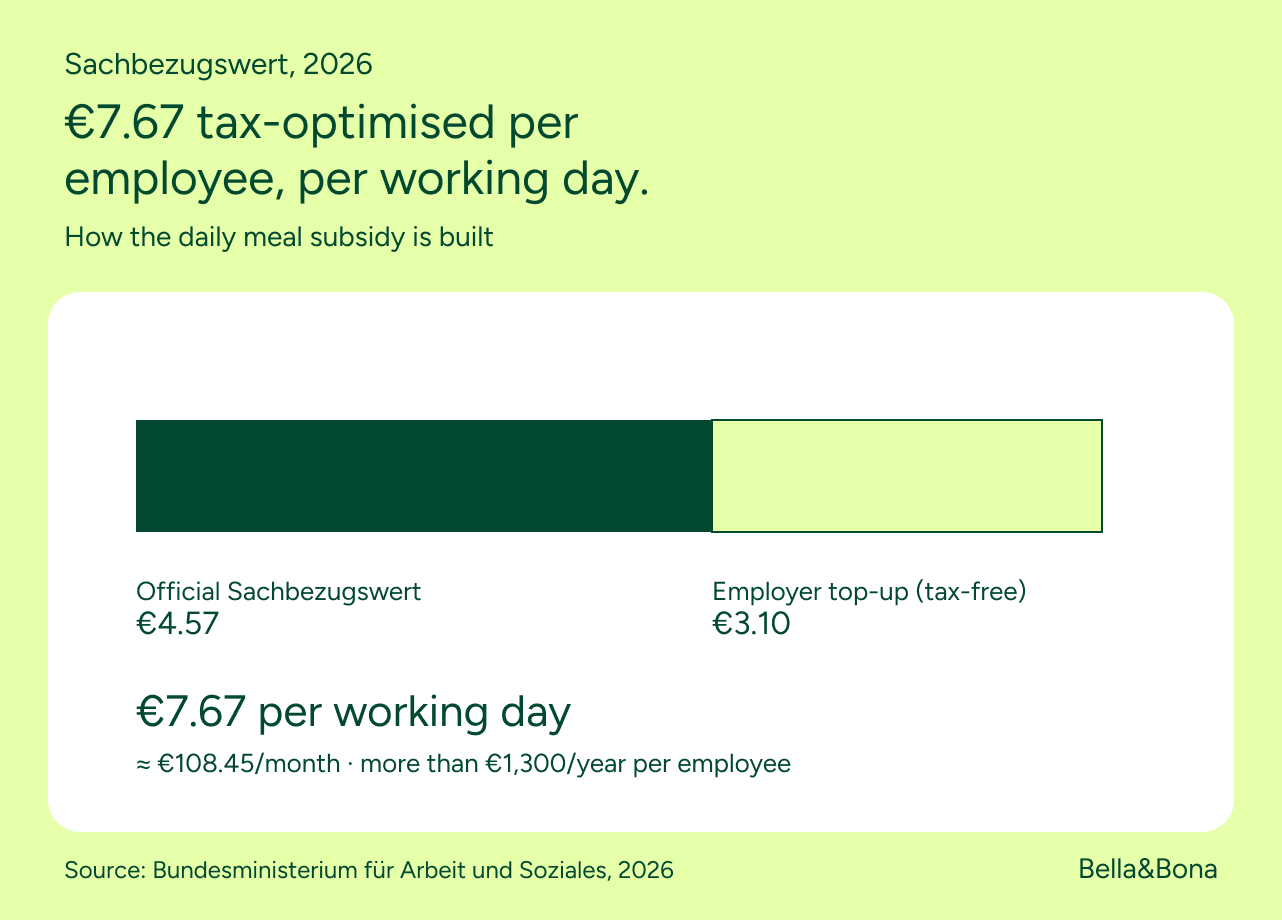
As of 2026, employers can subsidise up to €7.67 per working day per employee in tax-optimised meal benefits. This figure combines the official Sachbezugswert of €4.57 per meal and an additional employer contribution of €3.10, which is exempt from tax and social security contributions.
The total Sachbezug for full board (free catering) is set at €345 per month in 2026, an increase of €12 from the previous year, reflecting the adjustment to current consumer price levels made annually by the German Federal Ministry of Labour and Social Affairs (BMAS).
In practical terms for a company in Berlin or Munich: in Germany, up to €108.45 per month can be granted tax-free for meals — more than €1,300 per year per employee.
A salary increase of equivalent value would cost the employer more in social security contributions and deliver less net value to the employee after income tax. A daily lunch programme, structured correctly under the Sachbezugswert rules, delivers more value to the employee per euro spent by the employer than almost any equivalent cash benefit. It is one of the few areas in German employment tax law where everyone genuinely wins — employer, employee, and HR administrator alike.
Why Benefits That Are Used Daily Beat Benefits Used Occasionally
The Roland Berger research points to a challenge that most HR teams recognise but struggle to solve: both employers and benefits providers struggle with a lack of transparency in the market, unsure which benefits employees really care about and what their competitors are doing.
Nine out of ten HR respondents in the Roland Berger survey say that offering five to ten "killer" benefits is more important than offering a broad spectrum of 20 to 30 benefits that employees do not make much use of.
Daily lunch passes the killer-benefit test on every dimension. It is used every working day, it is financially tangible, it is socially activating, and it is structurally tax-efficient. Benefits without a proper launch are like an intranet post without a link: they exist but nobody finds them. A daily lunch programme does not have a discovery problem. It arrives at the office at noon.
How German Companies Are Structuring Office Lunch in Practice

There is no single model, and the right approach depends on company size, office setup, and what the programme is trying to achieve.
Daily delivery programmes are the most common model for companies in the 30–200 person range across Berlin, Munich, Cologne, Dortmund, and Essen. A catering provider prepares fresh food in their own kitchen and delivers daily to the office. Employees order via an app, food arrives at an agreed time, and the employer subsidises part or all of the cost. There is no canteen infrastructure, no catering staff to manage, and no fixed overhead that persists on days when employees work from home.
This model scales directly with actual attendance. Employees benefit immediately from a higher tax-free catering subsidy that reduces their daily meal costs, and employers can continue to grant this subsidy in the form of meal vouchers, digital meal tokens, or canteen-related contributions.
Recurring event catering works as a complement for companies that want food to mark specific moments — a weekly team lunch on Thursdays, a monthly all-hands breakfast, a quarterly celebration. It creates shared eating rituals without the daily commitment, and is often the entry point before companies move to a full daily programme.
The canteen model remains relevant only at significant scale — typically 400 or more employees eating on-site every day. Below that headcount, the economics of a fixed kitchen and catering staff almost always make daily delivery the more cost-effective and flexible choice.
What Makes an Office Lunch Programme Actually Work
Not all programmes deliver the same results. The ones that genuinely move employee satisfaction and attendance share a consistent set of characteristics.
The food has to be genuinely good. A lunch programme that employees accept because it is convenient does not generate the positive daily association you are paying for. A programme that employees look forward to — one they choose to be in the office for — does. The difference is almost entirely in the kitchen. Providers that prepare food fresh in their own facilities, change the menu regularly, and treat dietary requirements as standard rather than as edge cases produce the kind of food that gets mentioned when employees talk about why they like working somewhere.
Dietary requirements must be covered without making a fuss. In any Berlin or Munich team of 30 or more people, you will have vegans, vegetarians, halal requirements, gluten intolerance, and specific allergies. A lunch programme that handles these naturally — with clear labelling, genuine variety, and no need for employees to request special treatment — signals inclusion without calling attention to itself. A programme that handles dietary needs as exceptions signals the opposite.
Daily frequency is non-negotiable for culture impact. The compounding effect of daily positive experience is what drives the retention and engagement metrics. A spectacular quarterly team dinner does less for daily morale than a consistently good daily lunch. The most important quality in a catering provider is not what the food is like at its best — it is what it is like on an average Wednesday.
The Competitive Pressure Is Growing
The demand for employee benefits in Germany will continue to grow, driven by employers' desire to strengthen their branding and improve recruitment and retention rates.
For companies in Berlin, this is already visible. Office lunch has moved from a differentiating benefit to an expected one in sectors where talent competition is highest. For companies in Munich, the shift is underway at established firms and accelerating fast in professional services and tech. For companies in NRW — Cologne, Dortmund, Essen, Düsseldorf — the window of differentiation is still open. Introducing a daily lunch programme in NRW today positions a company meaningfully above most local competitors. That window will not remain open indefinitely.
The engagement data from Gallup says that Germany's employees are disengaged at historic levels. The productivity research from the ILO says that nutrition is one of the most underinvested drivers of performance. The benefits market data from Roland Berger says that food is already in the "Big 5" of what German HR teams prioritise. The Cornell research says that teams that eat together perform better together.
None of this is a coincidence. It is a converging case for an investment that is daily, universal, tax-efficient, and — when done well — the benefit employees talk about most.
FAQ
Why is office lunch considered a valuable employee benefit in Germany?
Office lunch is used every working day, has universal participation, delivers visible financial value to employees, and activates the social interaction that builds team cohesion. It is also one of the most tax-efficient benefits available to German employers under the Sachbezugswert rules — delivering more net value per euro spent than a cash equivalent.
What is the Sachbezugswert for meals in Germany in 2026?
The 2026 Sachbezugswert for lunch and dinner is €4.57 per meal per day. Combined with the additional employer contribution of €3.10, employers can subsidise up to €7.67 per working day per employee in a tax-optimised meal benefit. Calculate your own savings here.
Does eating together at work actually improve performance?
Yes. Cornell University research published in the journal Human Performance found that teams who eat meals together have measurably better group job performance than teams who dine separately. The study's author Kevin Kniffin concluded that organisations should consider spending on shared meals as an investment in employee performance.
What does the ILO say about nutrition and workplace productivity?
The ILO found that adequate nourishment can raise national productivity levels by 20%, and that a 1% increase in caloric intake results in a 2.27% increase in general labour productivity.
How do you start an office lunch programme for a team in Germany?
The most practical starting point is a daily delivery service from a provider with their own kitchen. You define the employer subsidy per person per day, the provider handles ordering, preparation, and delivery, and employees order through an app. Most programmes can be set up within two weeks. Bella&Bona offers this across Berlin, Munich, and NRW from 30 people upwards.
Berlin, Munich & NRW
Offering office lunch to your team?
Fresh from our own kitchens. Flexible headcount, all dietary needs covered as standard.